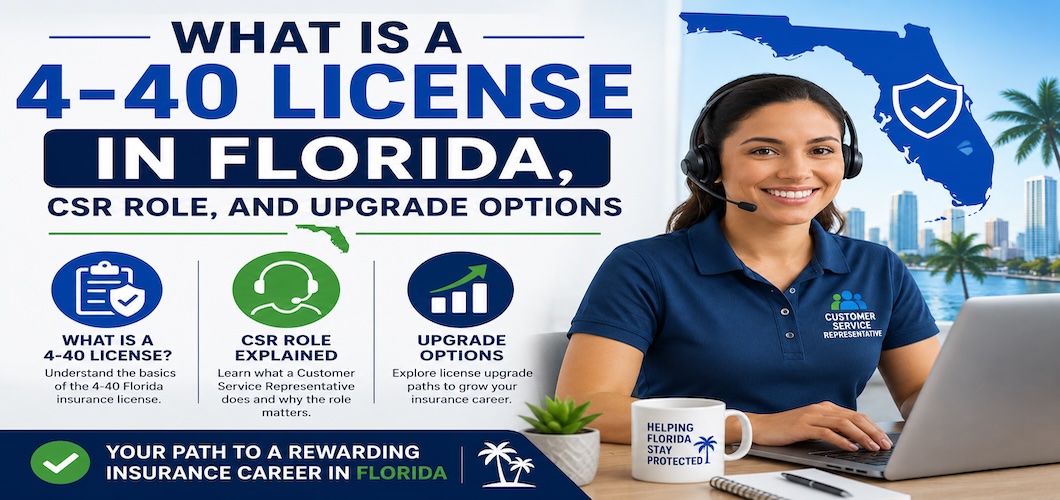
What Is a 4-40 License in Florida? CSR Role, Salary, and Upgrade Options
What Is a 4-40 (440) License in Florida?
If you’ve been looking at entry-level jobs in Florida insurance agencies, you’ve probably seen ads that mention a “440 license” or “4-40 Customer Representative” license.
Both terms are talking about the same thing: the Florida 4-40 Customer Representative license.
This license is designed for people who work inside a licensed insurance agency helping customers with their policies. It is a great way to get started in the insurance industry if you:
- Want a stable office job with regular hours.
- Prefer servicing existing clients rather than doing pure sales.
- Like the idea of learning insurance from the inside before deciding whether to become a full agent.
In this guide, we’ll look at what you can and cannot do with a 4-40, typical salary ranges, and how to use the 440 license as a stepping stone toward a 2-20 General Lines license if you choose.
What Can You Do With a 4-40 Customer Representative License?
With a 4-40 license in Florida, you usually work as an employee of an insurance agency, not as an independent agent. Your day-to-day work is focused on supporting customers and producers.
Typical 4-40 responsibilities include:
- Answering customer questions about their policies.
- Explaining coverage, deductibles, and basic policy terms.
- Taking information for quotes and helping prepare applications.
- Processing policy changes (endorsements), like adding or removing vehicles or drivers.
- Assisting with renewals and basic billing questions.
- Supporting 2-20 agents and producers by handling service tasks that keep clients happy.
You may work with:
- Personal insurance (home, auto, renters, etc.).
- Sometimes small commercial accounts, depending on the agency’s structure and supervision.
However, the agency’s 2-20 agents or appropriately licensed producers are ultimately responsible for the accounts and for any independent sales or production decisions.
What You Cannot Do With a 4-40 License
It’s just as important to understand the limits of the 4-40 license.
In general, a 4-40 Customer Representative cannot:
- Operate independently as an insurance agency or independent producer.
- Own an insurance agency as the primary licensed agent.
- Exercise the full level of authority that a 2-20 General Lines agent has over both personal and commercial accounts.
You work under the supervision of a fully licensed agent (often a 2-20). This is part of what makes the 4-40 a good fit for people who want to start in a support role and learn as they go.
Typical Job Titles and Work Settings for 4-40 Licensees
With a 4-40 license, you are most likely to see job titles such as:
- Customer Service Representative (CSR)
- Account Manager or Account Assistant (service-focused)
- Personal Lines CSR
- Service Team Member
Most 4-40 roles are found in:
- Independent insurance agencies
- Captive insurance agencies (representing one main carrier)
- Call center or service centers run by insurers
These roles are often full-time, office-based or remote positions with regular schedules. They appeal to people who like a structured environment and steady, predictable work helping clients with real-world problems.
4-40 License Salary: What Do Florida CSRs Typically Earn?
Salary can vary a lot based on location, agency size, and your experience level, but generally:
- Entry-level 4-40 CSRs often start with an hourly wage or modest salary.
- As you gain experience and become more efficient at handling complex service tasks, your pay can increase.
- Some agencies offer bonuses tied to retention, cross-selling assistance, or team performance.
Compared to commission-based sales roles, CSR positions tend to offer:
- More predictable income (less tied to new sales).
- Less pressure to hit production targets.
- A clearer 8-to-5 or 9-to-5 schedule.
If you like stability, organization, and helping people, a 4-40 position can be a great fit, even if your long-term goal is to eventually move into a higher-earning producer or agent role.
440 vs 220: How the 4-40 Compares to the 2-20 License
Many people considering the 4-40 license also hear about the 2-20 General Lines license and wonder which path they should choose.
Here’s a simple comparison:
Scope of authority
- 2-20 General Lines: Full property & casualty agent authority over both personal and commercial lines.
- 4-40 Customer Representative: Limited authority focused on customer service and certain sales-related tasks inside an agency.
Independence
- 2-20: Can act as a full agent, build a book of business, and pursue higher-level roles.
- 4-40: Works as an agency employee providing support and service.
Typical work focus
- 2-20: New business production, account management, and sometimes commercial accounts.
- 4-40: Policy changes, renewals, answering questions, and supporting producers.
Income potential
- 2-20: Higher long-term earning potential, especially if you work on commission or with large commercial clients.
- 4-40: More stable, salary/ hourly-based income with limited commission exposure.
If you’re not sure yet whether you want to take on the responsibility and sales focus of a 2-20 role, starting with a 4-40 can be a smart first step.
Who Is the 4-40 License Best For?
The 4-40 license is a strong fit if you:
- Enjoy customer service, problem-solving, and follow-through.
- Prefer a steady, support-focused position rather than a pure sales role.
- Want to learn the business from the inside before deciding whether to pursue a broader license.
- Are entering the industry through an agency that specifically hires for CSR roles.
Many employers are happy to bring in motivated people, help them get a 4-40, and then support their growth into more advanced roles over time.
How to Use a 4-40 License as a Stepping Stone to 2-20
One of the biggest advantages of starting with a 4-40 license is that it can serve as a launchpad to a 2-20 General Lines license later on.
A common upgrade path looks like this:
- Get hired by an agency in a service or support role.
- Complete your 4-40 pre-licensing course and obtain your 4-40 license with the state.
- Spend 1–2 years learning policy basics, service workflows, and how the agency operates.
- Talk with your employer about your interest in becoming a 2-20 agent. Many agencies will help with tuition or scheduling for your 2-20 course.
- Enroll in a Florida-approved 2-20 pre-licensing course (or a 2-20 conversion/desigation program if available and permitted) and prepare for the exam.
- Once you pass and get your 2-20, transition into a producer or higher-level account management role.
This path lets you build confidence and experience before you take on the full responsibility (and opportunity) of a 2-20 agent.
Education and Training for the 4-40 License
To earn a 4-40 license, you must complete the state’s education and licensing steps. An online pre-licensing course can make the process much smoother by:
- Breaking down core concepts like property, liability, and personal lines in plain English.
- Showing you realistic examples of the service situations you’ll handle as a CSR.
- Including practice questions that look and feel like the ones you’ll see on your exam (where applicable).
- Helping you track your progress so you know exactly when you’re ready to test.
When you choose a course provider, look for one that is Florida-approved, has a strong track record with Florida students, and offers clear support if you have questions.
Final Thoughts: Is the 4-40 License Right for You?
The 4-40 Customer Representative (440) license is one of the most accessible ways to enter the Florida insurance industry. It’s a great match if you:
- Want to work in insurance without going straight into a high-pressure sales role.
- Prefer a stable, service-oriented job structure.
- Like the idea of potentially upgrading to a 2-20 license in the future.
If that sounds like you, your next step is simple: confirm that your desired role requires a 4-40, enroll in a Florida-approved 4-40 pre-licensing course, and begin working through the material toward your license.