Florida 4-40 vs. 20-44 vs. 2-20 Insurance Licenses: What's the Difference?
If you're researching Florida insurance careers, you've probably come across license numbers such as 4-40, 20-44, and 2-20.
At first glance, the numbers can be confusing. All three are connected to Florida property and casualty insurance, but they do not provide the same authority or lead to exactly the same career opportunities.
Understanding the difference is important before you enroll in a Florida insurance licensing course.
In simple terms:
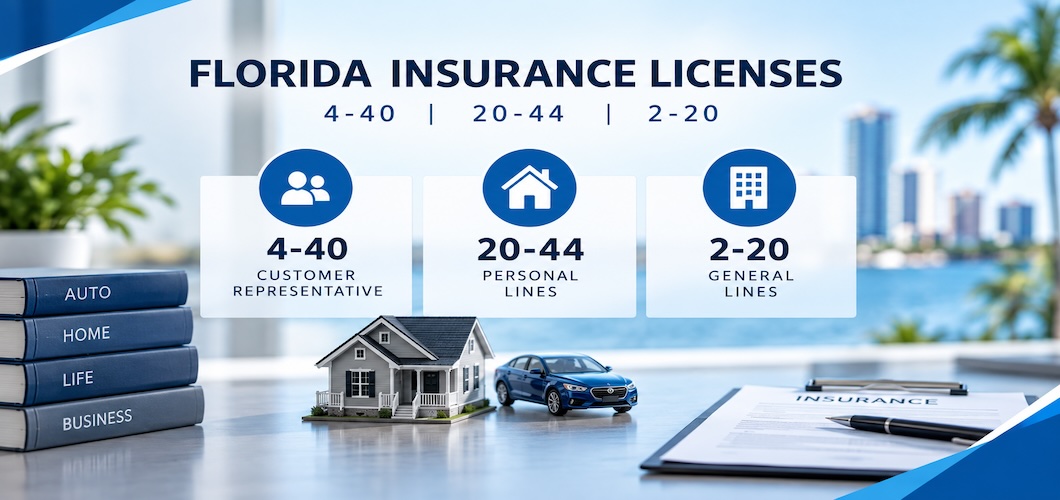
- 4-40 Customer Representative: Designed primarily for a salaried employee working under the supervision of a licensed General Lines agent.
- 20-44 Personal Lines: Allows an agent to transact personal lines property and casualty insurance for individuals and families for noncommercial purposes.
- 2-20 General Lines: Provides the broadest authority of these three licenses, covering General Lines property and casualty insurance and additional lines specified by Florida law.
The Florida Department of Financial Services (FLDFS) lists all three as Florida resident property and casualty license classes.
Quick Comparison: 4-40 vs. 20-44 vs. 2-20
| License | License Name | Primary Focus | Supervision | Career Direction |
|---|---|---|---|---|
| 4-40 | Customer Representative | Property & casualty customer service and transactions | Works under a supervising General Lines agent | Agency customer service / sales support |
| 20-44 | Personal Lines Agent | Personal property & casualty insurance | Agent license; requires appointment | Personal lines sales and service |
| 2-20 | General Lines Agent | Broad property & casualty insurance authority | Agent license; requires appointment | Broad P&C sales and agency careers |
While the three licenses overlap in some areas, their authority and career applications are different.
What Is a Florida 4-40 Insurance License?
The 4-40 Resident Customer Representative license is designed for individuals working as customer representatives for a General Lines insurance agent or agency.
FLDFS describes the 4-40 as a license for a salaried employee of a General Lines property and casualty agent or agency who may transact certain automobile, watercraft, home, motorcycle, and pet insurance business under the supervision of a licensed and appointed General Lines agent.
This makes the 4-40 particularly relevant for someone who wants to get started working inside an insurance agency without initially pursuing the broader 2-20 license.
What Can a 4-40 Customer Representative Do?
According to FLDFS, a licensed and appointed customer representative may perform activities such as taking applications, giving quotes, explaining policies and procedures, providing insurance advice, soliciting new customers from the agent's office, and binding certain new or additional coverages.
These activities are subject to the limitations of the customer representative license and the authority of the supervising agent or agency.
A 4-40 customer representative must also work under the required supervision. FLDFS specifically notes that customer representatives must be supervised by a General Lines agent and that the 4-40 license depends on maintaining the required appointment and supervision relationship.
Who Might Consider a 4-40?
The 4-40 can be worth exploring for someone who wants to:
- Enter the insurance industry
- Work for an insurance agency
- Build customer service and insurance experience
- Work in a sales-support or customer-service role
- Eventually pursue a broader insurance license
It can be particularly relevant for career changers who already have strong customer service, administrative, retail, or sales experience.
What Is a Florida 20-44 Insurance License?
The 20-44 Resident Personal Lines license is a step up in scope from the 4-40.
Florida defines a Personal Lines agent as a General Lines agent who is limited to transacting business involving property and casualty insurance sold to individuals and families for noncommercial purposes.
In practical terms, the 20-44 is focused on personal insurance rather than commercial insurance.
Examples can include personal coverage involving:
- Homes
- Automobiles
- Personal property
- Other personal property and casualty exposures
The exact products an agent can transact depend on the license authority, appointment, insurer appointments, and applicable Florida law.
Who Is the 20-44 Best Suited For?
The 20-44 may make sense for someone who wants to concentrate on personal insurance customers rather than pursue the broader range of business available under a 2-20 General Lines license.
It can be a useful option for someone interested in:
- Homeowners insurance
- Auto insurance
- Personal property coverage
- Personal lines sales
- Customer relationships with individual consumers and families
What Is a Florida 2-20 Insurance License?
The 2-20 Resident General Lines license is the broadest of these three Florida property and casualty licenses.
FLDFS identifies the 2-20 as the Resident General Lines license covering property, casualty, surety, marine, health, and miscellaneous lines. DFS lists common uses that include automobiles, watercraft, homes, motorcycles, pets, errors and omissions, workers' compensation, and bonds.
Because of its broader authority, the 2-20 can open the door to a wider range of insurance career opportunities.
Why Choose a 2-20?
A 2-20 may be appropriate for someone who wants to build a career around a broader range of property and casualty insurance rather than limiting their work primarily to personal lines.
Depending on appointments, agency structure, and the specific insurance products being handled, a General Lines agent may work with both personal and commercial insurance customers.
The 2-20 can therefore be relevant for people interested in building a long-term career in a property and casualty agency.
4-40 vs. 20-44: What's the Difference?
The biggest difference is role and authority.
A 4-40 is a Customer Representative license designed around working for an agent or agency under required supervision.
A 20-44 is a Personal Lines agent license focused on transacting personal property and casualty insurance for individuals and families for noncommercial purposes.
Someone considering these two licenses should ask:
- Do I want an agency customer-service role?
- Do I want to become a personal lines agent?
- Do I want to work primarily with consumers and families?
- Am I interested in eventually moving into broader P&C insurance?
20-44 vs. 2-20: What's the Difference?
The main difference between the 20-44 and 2-20 is the breadth of insurance authority.
The 20-44 is specifically limited to personal lines business for individuals and families for noncommercial purposes.
The 2-20 General Lines license has substantially broader authority and encompasses multiple property and casualty lines.
If you know that you want to specialize in personal insurance, the 20-44 may align with that goal.
If you want the broader General Lines path, the 2-20 is the license to investigate.
4-40 vs. 2-20: Is the 2-20 an Upgrade?
For many insurance professionals, the 2-20 represents a broader career path than the 4-40.
Florida's licensing requirements specifically recognize experience as a licensed and appointed 4-40 customer representative as one possible route toward qualifying for the 2-20, when combined with the required experience and additional 40-hour course. Florida DFS states that an applicant may qualify through one year of responsible insurance duties as a licensed and appointed 4-40, 20-44, or 0-55 representative plus completion of a Department-approved 40-hour course covering property, casualty, surety, marine, and health insurance.
This creates an important potential career progression:
4-40 Customer Representative → Experience → 2-20 General Lines
Another possible progression is:
4-40 Customer Representative → 20-44 Personal Lines → 2-20 General Lines
However, the exact requirements and qualifications should always be confirmed with the Florida Department of Financial Services before beginning an upgrade path.
Can a 4-40 Lead to a 20-44?
It can be part of a qualifying pathway.
FLDFS states that an applicant for the 20-44 can qualify through at least six months within the previous four years of responsible insurance duties as a licensed and appointed 4-40 Customer Representative, 4-42 Limited Customer Representative, or 0-55 Service Representative in qualifying personal lines business, followed by the other applicable licensing steps including passing the state exam.
This means the 4-40 can provide relevant experience for someone who eventually wants to move into a Personal Lines license.
What Are the Education Requirements?
The education requirements differ substantially among these licenses.
4-40 Customer Representative
A common route to obtaining the 4-40 license is to complete a 40-hour state approved insurance course after successfuly completing this course you can get your fingerprinting done and apply for your license. There is no state exam requirement.
Applicants should review the current FLDFS requirements carefully when deciding what license to pursue.
20-44 Personal Lines
FLDFS currently lists a 60-hour Department-approved insurance course covering property, casualty, and inland marine insurance as one qualification route for the 20-44, followed by the required application, fingerprinting, and state examination steps. There are also experience- and designation-based qualification routes.
2-20 General Lines
One primary education route for the 2-20 involves completing a 200-hour Department-approved property and casualty course within four years of application, followed by the required licensing steps and state examination.
Florida also provides alternative qualification routes involving insurance experience, certain college coursework, reciprocal licensing, or the CPCU designation.
Continuing Education: 4-40 vs. 20-44 vs. 2-20
Getting licensed is only the beginning of a Florida insurance career.
FLDFS currently lists different continuing education requirements for these license types.
For licensees subject to the standard requirements, the current CE chart lists:
- 4-40 Customer Representative: 4-hour Law and Ethics update plus 6 hours of elective credits.
- 20-44 Personal Lines: 4-hour Law and Ethics update plus 20 hours of elective credits.
- 2-20 General Lines: 4-hour Law and Ethics update plus 20 hours of elective credits.
FLDFS notes that the actual requirement should be verified through the licensee's MyProfile account because reductions or other circumstances may affect the requirement.
Which Florida License Should You Choose?
There isn't one license that is right for every aspiring insurance professional.
Your choice should depend on the type of work you want to perform.
Consider the 4-40 if:
- You want to work as a customer representative in an insurance agency.
- You are interested in customer service and insurance sales support.
- You want to build insurance experience before pursuing a broader license.
- You prefer working within a structured agency environment.
Consider the 20-44 if:
- You want to focus on personal lines.
- You want to work primarily with individuals and families.
- You are interested in home and auto-related insurance.
- You don't currently need the broader authority of a 2-20.
Consider the 2-20 if:
- You want the broadest property and casualty license of these three.
- You are interested in both personal and broader commercial insurance opportunities.
- You want to build a long-term General Lines insurance career.
- You may eventually want greater responsibility within an insurance agency.
Don't Choose a License Based Only on the Course Length
When comparing Florida insurance licenses, it can be tempting to choose the license with the shortest education requirement.
But that's not necessarily the best way to approach the decision.
Instead, start with the career you want.
If you want to work primarily in customer service under the supervision of an agent, the 4-40 may be worth investigating.
If you want to sell personal insurance to individuals and families, the 20-44 may be a better fit.
If your goal is a broader property and casualty career, the 2-20 may be the more appropriate license to research.
Choose the career direction first. Then choose the license that supports it.
Florida Insurance Licensing Can Be a Career Path, Not Just a First Job
One of the advantages of Florida's insurance licensing structure is that your first license doesn't necessarily have to be your final destination.
A person might begin in a customer service position, gain experience, move into Personal Lines, and eventually pursue a General Lines license.
That can create a progression such as:
Entry-Level Insurance Role → 4-40 → 20-44 and/or 2-20 → Expanded Career Opportunities
The exact path depends on your goals and qualifications, but understanding the differences between the licenses can help you make a more informed career decision.
Final Takeaway
The Florida 4-40, 20-44, and 2-20 licenses are not interchangeable.
The 4-40 Customer Representative is designed for a supervised agency role.
The 20-44 Personal Lines license focuses on property and casualty insurance sold to individuals and families for noncommercial purposes.
The 2-20 General Lines license provides the broadest authority of the three and can support a wider range of property and casualty insurance activities.
If you're considering a Florida insurance career, understanding these distinctions before enrolling in a course can help you select a licensing path that matches your professional goals.
Check out these articles to learn more about Florida Property and Casualty Insurance Licenses
Florida Insurance License Requirements: A Complete 2026 GuideHow Do You Get a Florida 2-20 General Lines Insurance License?
What Is a Florida 4-40 License and How Do You Get One?
Florida 20-44 Personal Lines License vs 2-20: Which Is Right for You?