Leveraging Local Market Data to Build Instant Credibility
When you're a brand-new Florida real estate agent, one of the biggest challenges isn't learning how to schedule a showing or write an offer. It's building trust.
Florida buyers and sellers want an agent who understands the market. They want someone who can explain why one neighborhood may be moving quickly while another has homes sitting on the market for months. They want to know whether a particular ZIP code has rising inventory, how long homes are taking to sell, and whether sellers are negotiating on price.
The good news is that you don't need 10 years of experience to begin developing that expertise.
You need to learn how to read local Florida real estate market data and, more importantly, explain what that data means to your clients.
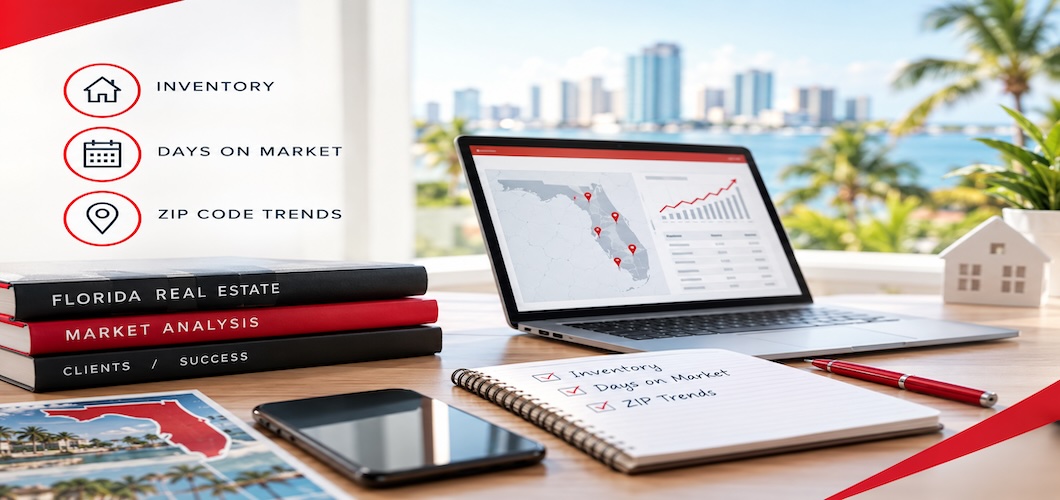
By consistently tracking inventory, days on market, new listings, price reductions, recent sales, and ZIP-code trends, a new agent can quickly become a more confident and credible resource.
Why Local Market Knowledge Matters in Florida
Real estate is local and that is particularly important in Florida.
Florida is not one single housing market. Conditions can vary dramatically from one county, city, neighborhood, or ZIP code to another.
A coastal South Florida market may behave very differently from an inland Central Florida community. A resort-oriented market can have different buyer and seller dynamics than a neighborhood dominated by year-round residents. A new-construction community may also behave differently from an established neighborhood with older homes.
Even within the same city, two ZIP codes can tell very different stories.
That is why new Florida agents should avoid relying exclusively on statewide or national headlines.
Instead, learn to answer questions such as:
- How much inventory is available in my target ZIP codes?
- How quickly are homes actually selling?
- Are prices trending upward, downward, or remaining relatively stable?
- Are sellers reducing asking prices?
- What price ranges have the most competition?
- Are buyers competing for certain types of properties?
- How does one neighborhood compare with a nearby neighborhood?
Those are the questions that can make your market knowledge useful to a Florida buyer or seller.
Start With Your Florida MLS Data
One of the most valuable resources available to a Florida real estate agent is the local MLS and the market reports available through your brokerage, REALTOR® association, or MLS organization.
Use these resources to develop a regular habit of reviewing what's happening in the areas you serve.
Rather than trying to memorize every statistic, choose several ZIP codes or neighborhoods and monitor them consistently.
Over time, you'll begin recognizing patterns that aren't obvious from statewide statistics.
1. Track Housing Inventory
Inventory is one of the first numbers a new agent should learn to monitor.
Inventory tells you how much property is available to buyers and can provide important context for the level of competition in a market.
For example, if you're working with a buyer looking at homes in a particular Florida ZIP code, knowing the current number of active listings can help you explain how much choice the buyer has.
If inventory is limited, desirable properties may attract more attention. If inventory is substantially higher, buyers may have more opportunities to compare properties and negotiate.
But don't stop at the county level.
Compare ZIP codes.
A county can show relatively stable inventory while individual neighborhoods experience very different conditions.
2. Watch Days on Market
Days on market (DOM) is another essential metric.
Look at how long homes are taking to go under contract or sell in the specific price range and geographic area you're serving.
For example, if properly priced homes in a particular Florida neighborhood are consistently going under contract quickly, buyers may need to be prepared to act when the right property appears.
On the other hand, if homes are routinely sitting on the market for extended periods, buyers may have more time to compare properties and negotiate.
For sellers, days on market can help explain why pricing strategy and property presentation matter.
Don't simply quote a county-wide DOM number. Compare:
- Different ZIP codes
- Different price ranges
- Single-family homes vs. condos
- New construction vs. resale properties
- Waterfront vs. non-waterfront properties when applicable
This level of detail can make your market conversations much more meaningful.
3. Pay Attention to Florida ZIP-Code Trends
Learning your ZIP codes is one of the fastest ways to develop local expertise.
Pick several areas where you want to build your business and track them every week or month.
Look at:
- Median sale price
- Average sale price
- Active inventory
- New listings
- Pending sales
- Closed sales
- Days on market
- Price reductions
- Sale-to-list price ratios
- Property types
Over time, you'll begin to understand what makes each area different.
That knowledge can become a competitive advantage for a new agent.
4. Understand Florida's Seasonal Market Patterns
Florida's real estate market can also be influenced by seasonal activity.
Depending on the part of the state, buyer activity can be affected by tourism, seasonal residents, weather, school calendars, migration patterns, and employment trends.
Some Florida markets also experience increased activity from buyers relocating from other states.
Rather than assuming that every month will look the same, compare current activity with previous months and, when appropriate, the same period in previous years.
This can help you distinguish between a short-term change and a longer-term trend.
5. Compare Condos and Single-Family Homes
Florida agents should be particularly careful about treating all residential properties as though they are part of the same market.
A condo and a single-family home in the same ZIP code can have very different considerations.
For condos, buyers may be evaluating factors such as association fees, reserves, building condition, assessments, amenities, and association rules.
For single-family homes, buyers may place greater emphasis on lot size, roof age, insurance considerations, renovations, flood exposure, and maintenance.
As an agent, understanding these differences can make your market analysis much more useful.
6. Watch Price Reductions
Price reductions can tell you something about how sellers are responding to current market conditions.
If you notice an increasing number of listings receiving price reductions in a particular ZIP code or price range, investigate further.
Ask:
- Are homes initially being priced too aggressively?
- Are buyers becoming more selective?
- Is inventory increasing?
- Are certain property types experiencing more reductions?
- Are homes that are priced competitively still selling quickly?
These observations can help you have a more informed conversation with a seller about pricing strategy.
7. Don't Ignore Florida-Specific Property Considerations
Florida real estate agents have another reason to develop strong local knowledge: properties can have issues that aren't equally important in every market.
Depending on the location and property, buyers may need to consider factors such as:
- Flood zones
- Wind exposure
- Hurricane-related construction features
- Roof age and condition
- Homeowners insurance availability and cost
- Wind mitigation features
- Flood insurance
- Condominium association fees and assessments
- HOA fees and restrictions
- New construction
You don't need to become an insurance expert to be a knowledgeable real estate agent. However, understanding which property characteristics may require additional questions or professional guidance can make you more valuable to clients.
Never guess when a question involves insurance, flood requirements, legal issues, inspections, or another specialized area. Know when to refer the client to the appropriate licensed professional.
8. Turn Statistics Into Useful Client Conversations
Knowing the numbers is only half the job.
The real skill is explaining what those numbers mean.
Instead of telling a buyer:
"There are 3.2 months of inventory."
Try:
"Inventory in this ZIP code has increased compared with earlier in the year, which means you're seeing more choices. We can take a little more time to compare properties, but we'll still want to pay attention to homes that are priced well and attracting multiple showings."
That's more useful because you're translating data into a real-world implication.
Clients don't need an agent who simply reads statistics to them. They need an agent who can help them understand what the statistics could mean for their particular situation.
Use Local Data During Buyer Consultations
Market data can help you answer common questions from Florida buyers.
A buyer might ask:
"Should we wait for prices to come down?"
Instead of making a prediction, examine the available local data.
Look at recent sales, inventory, days on market, price reductions, and pending activity.
You might explain:
"Here's what the recent data shows in the ZIP codes you're considering. Let's look at the trend together and then determine how it fits with your budget, timeline, and goals."
This keeps the conversation grounded in evidence rather than speculation.
Use Local Data During Listing Presentations
Sellers also benefit from local market knowledge.
When preparing for a listing presentation, study the property's immediate market.
Look at comparable properties that are:
- Currently active
- Pending
- Recently sold
- Recently reduced in price
- Similar in size, condition, location, and property type
Then use that information to explain the competitive landscape.
Instead of saying, "I think your home is worth $500,000," you can explain how comparable properties and recent market activity support your pricing recommendation.
Remember that market statistics are not a substitute for a proper comparative market analysis (CMA). They are tools that help you understand and explain the market.
Create a Florida Market Snapshot Every Week
One of the easiest ways for a new agent to become more knowledgeable is to create a simple weekly market routine.
Step 1: Choose Your Target ZIP Codes
Start with three to five ZIP codes where you want to build your business.
Step 2: Review New Listings
See what's coming onto the market and what types of properties are being listed.
Step 3: Check Pending Sales
Pending properties can provide clues about current buyer activity.
Step 4: Review Closed Sales
Study what actually sold, how quickly it sold, and how the final price compared with the asking price.
Step 5: Look for Price Reductions
Identify patterns among homes that aren't selling at their original asking price.
Step 6: Write Down Three Observations
At the end of your review, write down three things you learned.
For example:
- "Homes under $400,000 are moving faster than homes above $700,000."
- "Inventory increased in this ZIP code during the past month."
- "Several listings over $600,000 have received price reductions."
Do this consistently and you'll quickly develop a working knowledge of your local market.
Don't Try to Sound Like a Veteran—Become the Local Expert
New agents sometimes make the mistake of believing they need to sound like they've been selling real estate for decades.
You don't.
Instead, focus on becoming extremely knowledgeable about the market you're actually serving.
Know the neighborhoods. Know the ZIP codes. Know the price ranges. Know what is selling. Know what isn't selling. Know how inventory is changing.
Most importantly, know what questions you need to ask when the data doesn't tell the entire story.
Your credibility won't come from pretending to have experience you don't have.
It will come from being prepared, accurate, honest, responsive, and consistently informed.
Keep Building Your Florida Real Estate Knowledge
Getting your Florida real estate license is just the beginning of your professional education.
Successful agents continue learning as markets change, regulations evolve, and client expectations grow.
Continuing education can help Florida real estate professionals stay current while developing the knowledge and skills needed to build a long-term career.
If you're a new Florida agent, don't wait until you've been in the business for years to start developing expertise. Start with your local market today.
Post-licensing education and continuing education can help Florida real estate professionals stay current, strengthen their knowledge, and continue developing their professional skills.
Ready to keep learning?
Final Takeaway
You don't need years of transactions to provide valuable market insight.
You need to know where to find the data, how to evaluate it, and how to explain it to your clients.
For Florida real estate agents, that means going beyond statewide headlines and learning the markets where you actually work.
Track inventory. Study days on market. Monitor ZIP-code trends. Watch price reductions. Compare property types. Pay attention to Florida-specific considerations.
Then turn those observations into useful conversations with buyers and sellers.
Local market knowledge builds confidence. Confidence builds trust. And trust can help turn a new Florida real estate agent into a long-term professional.