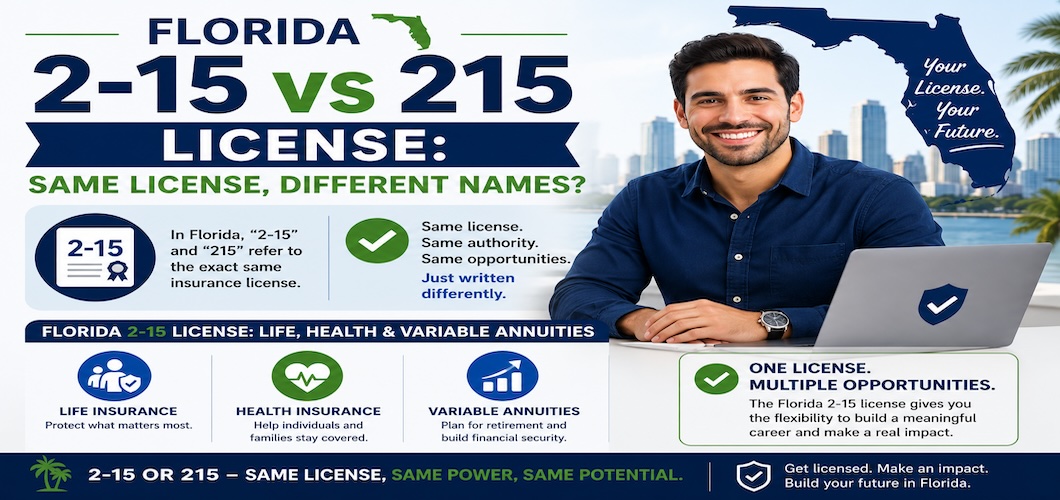
Florida 2-15 vs 215 License: Same License, Different Names?
Why “2-15” and “215” Cause So Much Confusion
If you’ve been researching Florida life and health licenses, you’ve probably seen two slightly different ways of writing the same thing:
- 2-15 license
- 215 license
You’ll see both in Google searches, job ads, and even in conversation with people already working in the industry. That naturally leads to a big question:
“Is there a difference between a 2-15 and a 215 license in Florida?”
In practice, when people talk about “2-15” or “215,” they are referring to the same Florida Life, Health and Variable Annuities agent license. The dashes and formatting are just different ways of writing the same license code.
In this article, we’ll clear up the naming confusion, explain what the 2-15 license allows you to do, and help you decide if it’s the right license for your career goals.
2-15 vs 215: Is There Any Real Difference?
From a licensing standpoint, “2-15” and “215” are used interchangeably to describe the Florida Life, Health and Variable Annuities Agent license.
- The Florida Department of Financial Services (FLDFS) and many schools use the 2-15 format.
- Job seekers and some employers may shorten it to 215 in postings or conversation.
They are not separate licenses with different powers or exams. If a job posting says “215 Life & Health license required,” they are almost certainly talking about the same 2-15 Life, Health and Variable Annuities license.
So, when you see either term, you can think:
2-15 = 215 = Florida Life, Health and Variable Annuities Agent
The important part is understanding what that license lets you do.
What the Florida 2-15 (215) License Allows You to Do
The 2-15/215 license is the combined Life & Health producer license in Florida. With it, you are authorized to:
- Sell and service life insurance products (term, whole life, universal life, etc.).
- Sell and service health insurance products (individual and group health plans, accident and sickness).
- Work with variable annuities (subject to any additional securities requirements that may apply in your role).
This combination makes the 2-15 one of the most versatile licenses on the life & health side of the industry. You can help clients with:
- Protecting their families’ income through life insurance.
- Managing medical expenses and coverage through health plans.
- Building long-term savings and retirement strategies with annuities (where permitted).
Because you can offer solutions in all three areas, you can build deeper, more comprehensive relationships with your clients.
Typical Jobs That Ask for a 2-15 or 215 License
You’ll see the 2-15/215 license mentioned in many different job postings, such as:
- Life & Health Insurance Agent
- Benefits Advisor or Employee Benefits Consultant
- Medicare or ACA Health Agent (often combined with life products)
- Financial Services Representative (when combined with other financial licenses)
- Agency Producer or Account Executive (life/health focus)
Employers that use this license include:
- Large national and regional insurance carriers
- Independent agencies that sell both life and health products
- Benefits-focused firms working with employer group plans
If a job ad says “2-15 or 215 license required,” you can treat that as the same requirement.
2-15/215 vs Other Florida Life & Health Licenses
Understanding how the 2-15 compares to other codes can help you see why it’s so popular.
Common Florida life & health-related licenses include:
- 2-15 – Life, Health and Variable Annuities Agent (sometimes written as 215)
- 2-14 – Life Including Variable Annuities Agent (life-focused, no health)
- 2-40 – Health Agent (health-focused, no life)
Here’s how they compare:
Scope of authority
- 2-15 / 215: Life + Health + Variable Annuities (broadest of the three).
- 2-14: Life + Variable Annuities only.
- 2-40: Health insurance only.
Best for
- 2-15 / 215: People who want to work across both life and health, offering full protection packages.
- 2-14: Those who want to focus on life and annuity products without dealing with health insurance.
- 2-40: Those who want to focus on health and benefits plans only.
If you’re not sure yet whether you’ll prefer life or health, the 2-15 gives you options on both sides.
Why Employers and Schools Still Use Different Names
You might wonder why, if they’re the same license, there are still two ways of writing the code.
A few common reasons:
- Shorthand: People often drop the dash when typing quickly (2-15 → 215).
- Old habits: Some offices or HR systems have used a particular format for years and haven’t updated it.
- Search behavior: Job seekers and students type what they hear, so both “2-15” and “215” show up in search data.
For you as a future agent, the takeaway is simple: you don’t need to apply for separate “2-15” and “215” licenses. They are the same thing.
What the 2-15 (215) Exam and Course Typically Cover
To get your 2-15 license, you’ll need to complete the required pre-licensing education and pass the state exam.
A good Florida 2-15 course will cover topics such as:
- Basic insurance concepts (risk, insurable interest, underwriting basics).
- Life insurance types: term, whole life, universal life, variable products.
- Health insurance basics: medical plans, major medical, HMOs/PPOs, deductibles, co-pays, coinsurance.
- Disability income and other related coverages.
- Annuities and how they work in retirement planning.
- Florida-specific laws and regulations that apply to life and health agents.
- Ethics, suitability, and replacement rules.
Strong online courses break this content into short, focused lessons and give you practice questions that look like the ones you’ll see on the exam.
Is the 2-15/215 License Right for You?
The 2-15 (or 215) license is usually the best choice if you:
- Want to work in both life and health insurance, not just one or the other.
- Are interested in comprehensive client planning, from income protection to health coverage and retirement savings.
- Want maximum flexibility to move between different roles and employers in the life and health space.
It might not be the best first step if:
- You are certain you only want to focus on life/annuity (in which case 2-14 could be enough).
- You know you only want to work with health insurance and benefits (2-40 might be a better fit).
But if you’re even a little unsure, the 2-15/215 gives you the broadest foundation and keeps your options open.
Next Steps if You’re Ready for a 2-15 (215) License
If you’ve decided this is the right license for you, here’s a simple action plan:
- Confirm that your target employer or desired role lists 2-15, 215, or “Life, Health and Variable Annuities” as the required license.
- Enroll in a Florida-approved 2-15 pre-licensing course that explains everything in clear, everyday language and includes plenty of exam-style questions.
- Set a realistic study schedule that fits your life (for example, evenings and weekends if you’re working full-time).
- Use quizzes and practice exams to track your progress and identify topics you need to review again.
- Schedule and take the state exam once your practice scores consistently reach your target range.
- Apply for your license with the Florida DFS and complete any required background steps.
Remember: whether someone calls it the 2-15 or the 215 license, they’re talking about the same credential. Once you have it, you’ll be licensed to help clients across the full spectrum of life, health, and annuity needs in Florida.
Florida 2-15 vs 215 License: Same License, Different Names?
Why “2-15” and “215” Cause So Much Confusion
If you’ve been researching Florida life and health licenses, you’ve probably seen two slightly different ways of writing the same thing:
- 2-15 license
- 215 license
You’ll see both in Google searches, job ads, and even in conversation with people already working in the industry. That naturally leads to a big question:
“Is there a difference between a 2-15 and a 215 license in Florida?”
In practice, when people talk about “2-15” or “215,” they are referring to the same Florida Life, Health and Variable Annuities agent license. The dashes and formatting are just different ways of writing the same license code.
In this article, we’ll clear up the naming confusion, explain what the 2-15 license allows you to do, and help you decide if it’s the right license for your career goals.
2-15 vs 215: Is There Any Real Difference?
From a licensing standpoint, “2-15” and “215” are used interchangeably to describe the Florida Life, Health and Variable Annuities Agent license.
- The Florida Department of Financial Services (FLDFS) and many schools use the 2-15 format.
- Job seekers and some employers may shorten it to 215 in postings or conversation.
They are not separate licenses with different powers or exams. If a job posting says “215 Life & Health license required,” they are almost certainly talking about the same 2-15 Life, Health and Variable Annuities license.
So, when you see either term, you can think:
2-15 = 215 = Florida Life, Health and Variable Annuities Agent
The important part is understanding what that license lets you do.
What the Florida 2-15 (215) License Allows You to Do
The 2-15/215 license is the combined Life & Health producer license in Florida. With it, you are authorized to:
- Sell and service life insurance products (term, whole life, universal life, etc.).
- Sell and service health insurance products (individual and group health plans, accident and sickness).
- Work with variable annuities (subject to any additional securities requirements that may apply in your role).
This combination makes the 2-15 one of the most versatile licenses on the life & health side of the industry. You can help clients with:
- Protecting their families’ income through life insurance.
- Managing medical expenses and coverage through health plans.
- Building long-term savings and retirement strategies with annuities (where permitted).
Because you can offer solutions in all three areas, you can build deeper, more comprehensive relationships with your clients.
Typical Jobs That Ask for a 2-15 or 215 License
You’ll see the 2-15/215 license mentioned in many different job postings, such as:
- Life & Health Insurance Agent
- Benefits Advisor or Employee Benefits Consultant
- Medicare or ACA Health Agent (often combined with life products)
- Financial Services Representative (when combined with other financial licenses)
- Agency Producer or Account Executive (life/health focus)
Employers that use this license include:
- Large national and regional insurance carriers
- Independent agencies that sell both life and health products
- Benefits-focused firms working with employer group plans
If a job ad says “2-15 or 215 license required,” you can treat that as the same requirement.
2-15/215 vs Other Florida Life & Health Licenses
Understanding how the 2-15 compares to other codes can help you see why it’s so popular.
Common Florida life & health-related licenses include:
- 2-15 – Life, Health and Variable Annuities Agent (sometimes written as 215)
- 2-14 – Life Including Variable Annuities Agent (life-focused, no health)
- 2-40 – Health Agent (health-focused, no life)
Here’s how they compare:
Scope of authority
- 2-15 / 215: Life + Health + Variable Annuities (broadest of the three).
- 2-14: Life + Variable Annuities only.
- 2-40: Health insurance only.
Best for
- 2-15 / 215: People who want to work across both life and health, offering full protection packages.
- 2-14: Those who want to focus on life and annuity products without dealing with health insurance.
- 2-40: Those who want to focus on health and benefits plans only.
If you’re not sure yet whether you’ll prefer life or health, the 2-15 gives you options on both sides.
Why Employers and Schools Still Use Different Names
You might wonder why, if they’re the same license, there are still two ways of writing the code.
A few common reasons:
- Shorthand: People often drop the dash when typing quickly (2-15 → 215).
- Old habits: Some offices or HR systems have used a particular format for years and haven’t updated it.
- Search behavior: Job seekers and students type what they hear, so both “2-15” and “215” show up in search data.
For you as a future agent, the takeaway is simple: you don’t need to apply for separate “2-15” and “215” licenses. They are the same thing.
What the 2-15 (215) Exam and Course Typically Cover
To get your 2-15 license, you’ll need to complete the required pre-licensing education and pass the state exam.
A good Florida 2-15 course will cover topics such as:
- Basic insurance concepts (risk, insurable interest, underwriting basics).
- Life insurance types: term, whole life, universal life, variable products.
- Health insurance basics: medical plans, major medical, HMOs/PPOs, deductibles, co-pays, coinsurance.
- Disability income and other related coverages.
- Annuities and how they work in retirement planning.
- Florida-specific laws and regulations that apply to life and health agents.
- Ethics, suitability, and replacement rules.
Strong online courses break this content into short, focused lessons and give you practice questions that look like the ones you’ll see on the exam.
Is the 2-15/215 License Right for You?
The 2-15 (or 215) license is usually the best choice if you:
- Want to work in both life and health insurance, not just one or the other.
- Are interested in comprehensive client planning, from income protection to health coverage and retirement savings.
- Want maximum flexibility to move between different roles and employers in the life and health space.
It might not be the best first step if:
- You are certain you only want to focus on life/annuity (in which case 2-14 could be enough).
- You know you only want to work with health insurance and benefits (2-40 might be a better fit).
But if you’re even a little unsure, the 2-15/215 gives you the broadest foundation and keeps your options open.
Next Steps if You’re Ready for a 2-15 (215) License
If you’ve decided this is the right license for you, here’s a simple action plan:
- Confirm that your target employer or desired role lists 2-15, 215, or “Life, Health and Variable Annuities” as the required license.
- Enroll in a Florida-approved 2-15 pre-licensing course that explains everything in clear, everyday language and includes plenty of exam-style questions.
- Set a realistic study schedule that fits your life (for example, evenings and weekends if you’re working full-time).
- Use quizzes and practice exams to track your progress and identify topics you need to review again.
- Schedule and take the state exam once your practice scores consistently reach your target range.
- Apply for your license with the Florida DFS and complete any required background steps.
Remember: whether someone calls it the 2-15 or the 215 license, they’re talking about the same credential. Once you have it, you’ll be licensed to help clients across the full spectrum of life, health, and annuity needs in Florida.